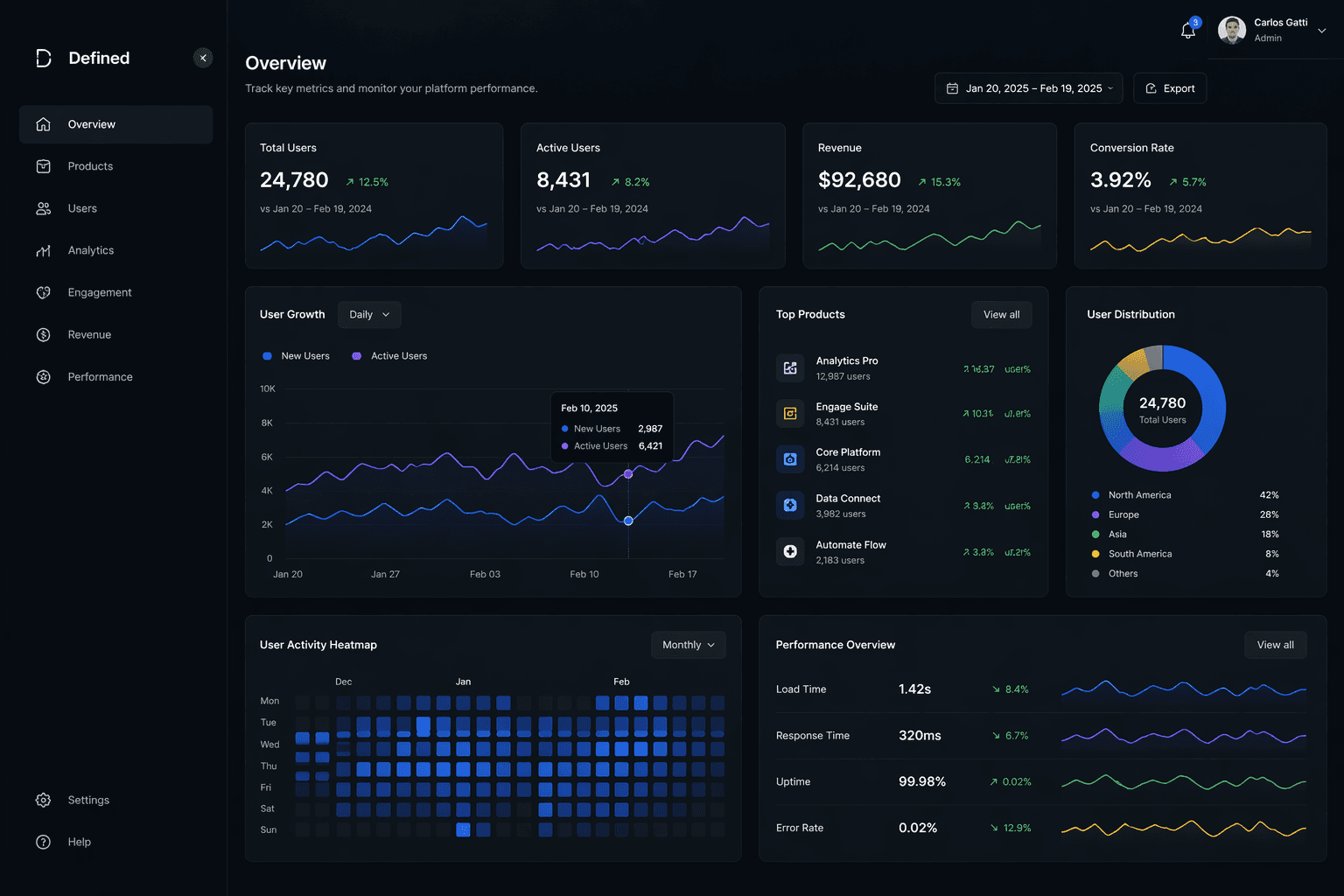
Data work fails for two opposite reasons: too little instrumentation (you fly blind), and too much visualization (you drown in charts).
The best operational setup is not “more dashboards.” It is a tight loop between what leaders need to decide and what teams can influence.
Start from decisions, not from databases
Before choosing tools, ask:
- What decision does this support?
- Who owns it?
- What action happens if the number moves?
- What is the acceptable lag?
If you cannot answer those, you are collecting data for curiosity — not for operations.
The metric stack that matters in the real world
Most organizations need three layers:
- Health metrics — are we stable?
- Growth metrics — are we expanding?
- Quality metrics — are we paying for growth with debt?
The mistake is mixing these into one “scoreboard” and calling it strategy.
From insight to cadence
A metric without a cadence is trivia. We like to pair metrics with rituals:
- Weekly: review leading indicators tied to experiments
- Monthly: review outcomes and reallocate effort
- Quarterly: sanity-check assumptions and positioning
A dashboard nobody reviews is expensive wallpaper.
What “good” looks like
Good operational data work is boring in the best way: it reduces surprises, shortens meetings, and makes tradeoffs explicit.
If your team spends more time debating definitions than improving outcomes, your instrumentation is upstream of your culture — and it is worth fixing.
When you are ready to connect brand, product, and operations into one coherent system, that is the kind of work we build with clients.